
Combi boilers — is one right for your home?
Heat and hot water on demand, no tanks, no airing-cupboard cylinder.
Not sure which type you need? The quote tool asks about your home and works it out with you.
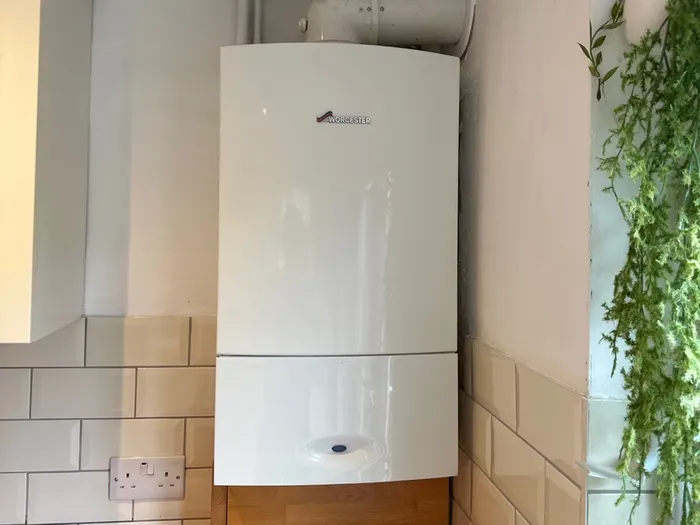
What is a combi boiler?
A combi — short for combination — is a single unit that does both jobs: it heats your radiators and it heats your hot water, on demand, straight from the mains. There is no hot-water cylinder in the airing cupboard and no cold tank in the loft.
Turn a tap on and the boiler fires up and heats the water as it passes through. That is why a combi never runs out of hot water — but it is also why the flow slows if two people try to use it at once.
Roughly seven in ten of the boilers we fit across East Kent are combis. For a typical two- or three-bedroom house with one bathroom, it is usually the obvious answer.
The honest pros and cons
We fit all three types. We have no reason to talk you into the wrong one.
Where it wins
- No cylinder and no loft tank — you get the airing cupboard and loft space back
- Hot water never runs out, so no waiting for a tank to reheat
- Cheaper and quicker to fit than a system boiler if you already have one
- Nothing stored hot, so no standing heat loss from a cylinder
- Mains-pressure showers without needing a pump
Where it falls down
- Flow rate is shared — run two showers at once and both go weak
- Only as good as your mains pressure. Poor incoming pressure means a poor combi
- No immersion heater, so if the boiler fails you have no hot water at all
- Not usually the right answer for a house with two or more bathrooms in regular use
- Cannot easily feed a traditional gravity-fed power shower
Is a combi boiler right for your home?
Find the row that sounds most like your house.
| Your home | Verdict | Why |
|---|---|---|
| Flat or 1–2 bed house, one bathroom | ✓ Good fit | Almost always the right choice. |
| 3 bed house, one bathroom + cloakroom | ✓ Good fit | The standard fit. A 30kW model handles it comfortably. |
| 4 bed house, two bathrooms | ~ Possible | Workable with a 35kW model and good mains pressure — but a system boiler is often better. |
| Two bathrooms used at the same time, every day | ✕ Not ideal | A combi will disappoint you. Go system. |
| Low or unreliable mains water pressure | ✕ Not ideal | Fix the pressure first, or stay with a stored-water system. |
| Home with a gravity-fed power shower you want to keep | ✕ Not ideal | A combi cannot feed it. You would need a different setup. |
What size combi boiler do I need?
Combi sizing is driven by hot water, not by radiators — the burner has to be big enough to heat water at the rate you draw it. As a rough guide:
| Your home | Typical size |
|---|---|
| Flat or small house, 1 bathroom, up to 10 radiators | 24–25 kW |
| 3 bed house, 1 bathroom + cloakroom, 10–15 radiators | 28–30 kW |
| 4 bed house, 2 bathrooms, 15–20 radiators | 32–35 kW |
These are starting points, not answers. The real number depends on your incoming mains flow rate, which we measure on the survey — a 35kW boiler on a weak main is money wasted.
What does a combi boiler cost to fit?
A like-for-like combi boiler replacement in a typical East Kent home lands between £2,800 and £3,900 fitted, including VAT. Where you sit in that range comes down to the size of boiler, the brand and warranty you choose, and how much pipework needs reworking.
Converting from a cylinder system to a combi is a different job — the tanks and cylinder come out and the pipework is reworked, so it typically runs from £4,650 to £5,750, and takes two to three days rather than one.
That is a guide, not a quote. We are not going to pretend a number off a web page is your price — the only way to know is to look at your home. The quote tool asks six questions and gives you a real fixed price for your house, with the boiler, the fitting and everything in the quote included. It takes about two minutes.
Switching from a tank system to a combi
This is the big one people underestimate. Going from a conventional or system setup to a combi is not a swap — it is a conversion. The cylinder comes out, the loft tanks come out, the pipework is reworked, and the whole system needs flushing properly because you are putting mains pressure through pipes that have never seen it.
It is usually a two to three day job rather than a one-day swap, and it costs materially more than a like-for-like replacement. It is often absolutely the right call — you gain a cupboard, a loft and a simpler system — but go in knowing it is a bigger project.
One thing worth checking before you commit: if the airing cupboard is doing a job you rely on for drying, you lose the heat source when the cylinder goes.
Common questions
How long does a combi boiler last?
A decent combi, serviced every year, should give you 10 to 15 years. We still see 20-year-old boilers running, but by then parts get scarce and efficiency has dropped a long way. If yours is past 12 and needing repairs, replacement usually works out cheaper over the next few years.
Can I run two showers at once with a combi?
Not well. A combi heats water as it flows, so the available hot water is split between the outlets. Two showers at once from one combi means two weak showers. If that is a daily occurrence in your house, you want a system boiler and a cylinder.
Do I need a water tank with a combi boiler?
No — that is the main appeal. No cold tank in the loft, no hot cylinder in the airing cupboard. Both come out during the conversion and the space is yours again.
What happens if my mains pressure is low?
A combi can only deliver what the mains gives it, so a weak main means weak hot water no matter how big the boiler. We measure flow rate at the survey before recommending anything. Sometimes the fix is upgrading the incoming supply; sometimes it means a combi is the wrong answer for that house.
Is a combi cheaper to run?
Usually, yes — because you are not keeping a tank of water hot around the clock, you avoid that standing heat loss. The bigger saving normally comes from replacing an old inefficient boiler with a modern condensing one, whatever type you choose.
Can a combi boiler be fitted anywhere?
Within reason. It needs a flue route to an outside wall, a gas supply of the right size, and a condensate drain. Kitchens and utility rooms are the usual spots. Moving it a long way from where the old one sat adds a day to the job and to the cost.
Still weighing it up?
The other two types, explained the same way.
Combi boiler installation across East Kent
We fit combi boilers from Deal and Dover across to Canterbury, Folkestone and Thanet — Gas Safe registered (№ 2836), 25 years at it, and next-day installation wherever we can.